

My first time at the Ryman was in 2001 or 2002. I can’t remember because what is time these days. Despite what Fox News talking heads parroted last year, I grew up blaring Patsy Cline and Hank Williams in our silver Nissan Altima, and some winter evening, the Behn family found ourselves huddled in the pews of the Mother Church when a toasted blonde gentleman walked on stage with a camcorder. In an Australian accent, he sputters, “Hey Ma, look I’ve finally made it!” It was Keith Urban’s inaugural performance at the Ryman Auditorium.
When the Grand Ole Opry packed up for the new theme park out in Donelson in 1974, the Ryman’s owner, National Life & Accident Insurance Company, the same conglomerate that ran WSM radio, didn’t plan to just walk away and let the building sit. Their consultants concluded the Ryman held “nothing of value” (probably because an adult cinema had opened up across the street, see below), and their actual plan, floated seriously in boardrooms, was to strip the building for parts. Haul out the sacrosanct pews and a few pieces of the lush stained glass, and reassemble a Picasso version of it forty-five minutes away as a decorative chapel inside Opryland USA, something they were reportedly going to call “The Little Church of Opryland.” A Cracker Barrel-esque gift shop with a steeple, built from the bones of the actual Mother Church, so tourists at the amusement park could get a whiff of authentic Nashville without the city having to spend the money to resurrect it.
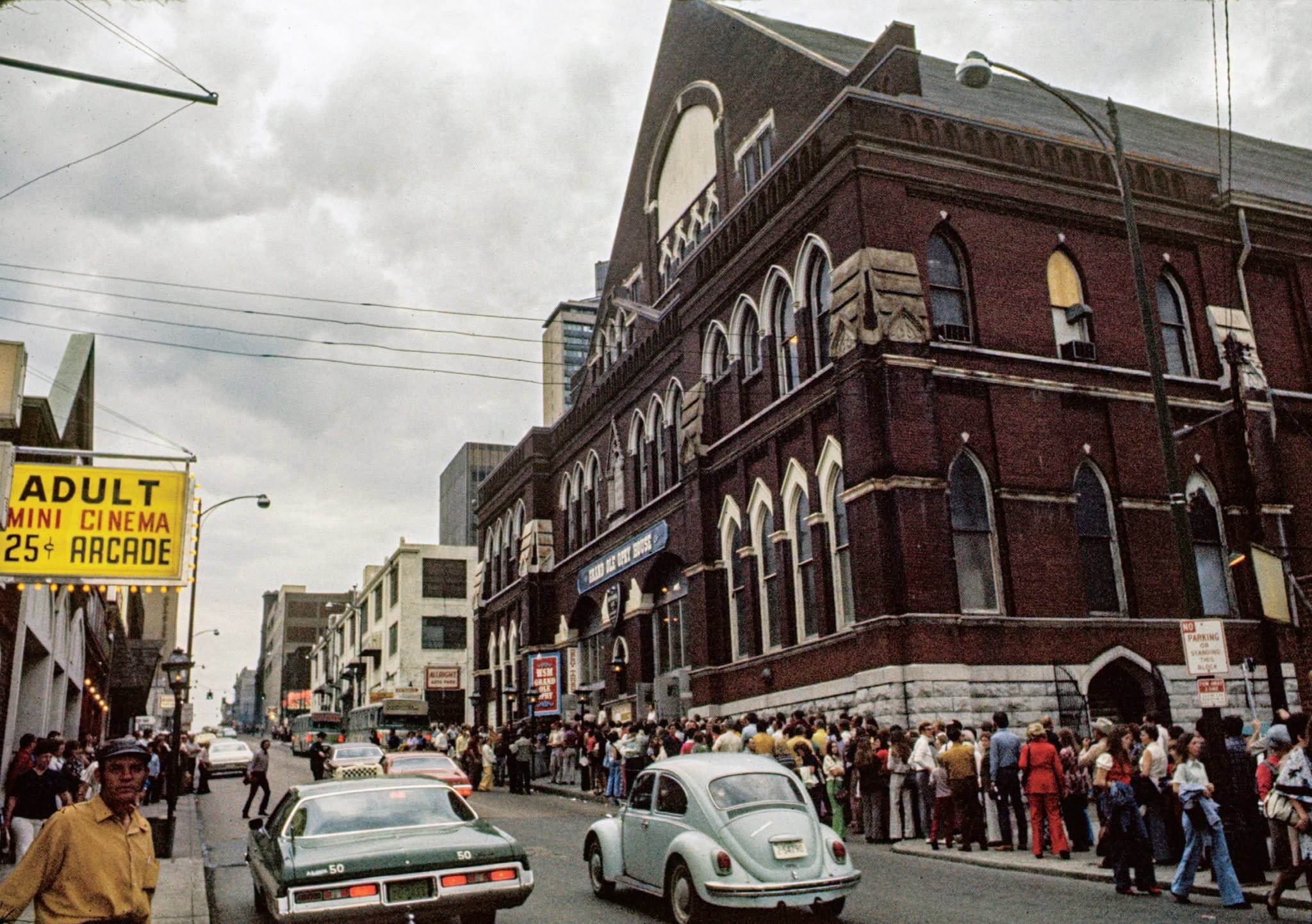
Roy Acuff, arguably the most powerful man in country music at the time and owner of many downtown buildings, backed the demolition and said he never wanted to hear another note played in the place. Vanderbilt’s own architectural historians later called it out plainly: in 1974, “Music City’s crown jewel was seen as a relic that should make way for progress.” MMMMMMHMMM, SOUNDS FAMILIAR. Most of the city’s institutional voice in the room agreed: tear it down, salvage the aesthetically framable pieces, move the money out to “the suburbs”, now affectionately called the Kingdom of Briley Parkway, where the land was cheaper at the time.
Ordinary Nashvillians, with the help of two U.S. senators, stopped that from happening. The public organized, National Life backed off, and then the building sat and rotted for two more decades anyway, because no one wanted to front the money to renovate it. In 1994, after Emmylou Harris cut a live album inside those walls, the Ryman reopened. A story every Nashvillian breathlessly recounts as if we were right there on stage with her.
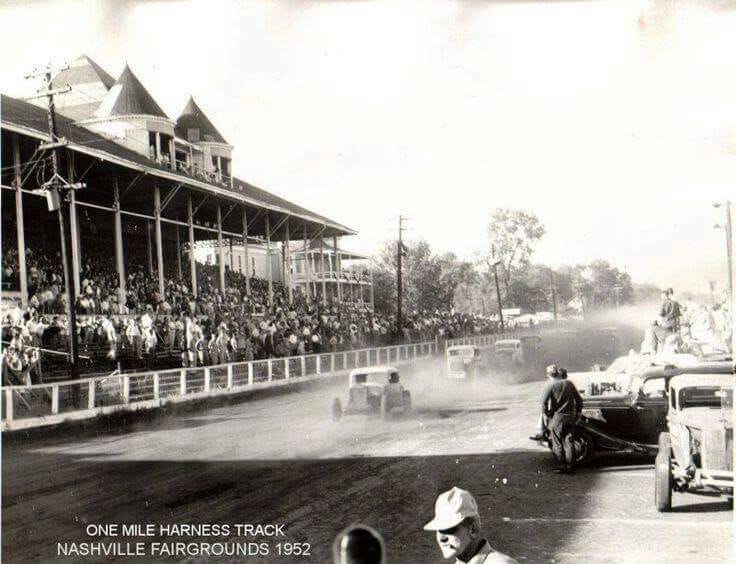
The Fairgrounds Speedway has hosted racing since 1891, a year before the Ryman opened. It is the second-oldest continuously operating racetrack in the United States, older than Indianapolis. Legends like Richard Petty, Dale Earnhardt and Darrell Waltrip raced and built their legacies at the Speedway. That land hosted the Tennessee State Fair, long before it became a mega-affair, and the flea market, where working-class Nashvillians used to shop as the wealthy suburbs expanded. People from that neighborhood, and from Wedgewood-Houston next door, have been attending those races and visiting the flea market for generations. This neighborhood and its amenities were once for the working poor, a respite from their grueling, sweat-soaked lives. In 1958, Nashville's own weekly Saturday-night racers, with no capital and no political connections, guys running what they called the "Legion Bowl" circuit, negotiated their own lease from the State Fair board and managed to build a paved half-mile track that shared a straightaway with the existing quarter-mile.
It’s now 2026. Two-bedroom rentals in Wedgewood-Houston are running $3,900 a month; one can’t find a house in that neighborhood for under $500K. Investors describe the neighborhood as “60 to 70 percent through its gentrification arc,” which is an obscene way to describe a place where working Nashvillians used to live and play. Metro’s own planning department had to write an entire overlay specifically to slow displacement in Wedgewood-Houston and Chestnut Hill, because the market was moving faster than local families could hold on. The transition from this neighborhood reflects the historical arc of so many Nashville neighborhoods and can be summarized as “there sure are a lot of Black Lives Matter signs where Black people used to live.”
So, let’s dig into the battle of the Fairgrounds Speedway and the players involved.
On one side, a coalition backed by John Ingram, the billionaire who owns Nashville SC and Geodis Park, is running a Metro Charter amendment petition AKA an astroturf campaign, to rip auto racing out of the city’s governing document entirely and replace it with a promise of affordable housing, needing signatures from ten percent of Davidson County’s registered voters to force it onto a ballot. A judge already threw out their first attempt this spring because the title didn’t clearly tell voters what they’d be signing. They refiled, and here we are. Their side is telling us that with the demolition of the Speedway, affordable housing will be ubiquitous. Imagine Oprah… YOU GET A HOUSE! YOU GET A HOUSE! EVERYBODY GETS A HOUSE! In this town, "affordable" has become the most flexible word in the English language. Is it 30% AMI or is it the usual Nashville sleight of hand, 80% or 120% AMI, "affordable" for somebody already clearing six figures, which is just market-rate housing wearing a name tag? Hey, remember when the Titans’ billionaire ownership and their army of perspicacious lobbyists convinced us to swallow the most expensive taxpayer-funded stadium in United States history with affordable housing dangled as the pitch to get it over the line?
Before you take the “affordable housing” pitch at face value, know this: Ingram already got ten acres of this exact public land handed to his development partner for free, back when Nashville agreed to his soccer stadium in 2018. That deal came with a signed community benefits agreement promising affordable housing and a childcare center on that land. Eight years later, only one phase is built. The childcare center is nowhere to be found. MarketStreet, his development partner, told the Banner this spring that future phases are on hold, and they specifically cited “the racetrack” as one of the reasons.
So the same coalition telling you to trust them with more Fairgrounds land for housing is sitting on an unfinished housing promise on the last parcel of Fairgrounds land they were handed??? The same MarketStreet that just closed a $23 million sale to an Atlanta data center company for land next to the Nashville Zoo, the one 557,000 Nashvillians signed a petition trying to stop, sitting right beside animals the zoo says the noise could actually harm???
On the other side is an amorphous deal that has been reluctantly handed off to the next Nashville mayoral administration like a wayward baton. The current version of the deal partners with Speedway Motorsports, a company built by the Smith family out of Concord, North Carolina, a racing dynasty that took itself private in 2019 in an $800 million buyout specifically so the family could stop answering to its public shareholders. They want to add the historic Speedway to their national portfolio, and the final stipulations of the deal remain unclear. Will public lands remain in public hands? Will Speedway Motors assume all the debt and risk?
Unfortunately, this story isn't straightforward, where one side is a hero and the other a villain. It’s more like Scylla and Charybdis through an undercurrent of municipal bonds… so, where do we steer our ship? If a state-of-the-art soccer stadium reads as urban progress to you, but a dilapidated racetrack reads as something lesser, it might not be a neutral judgment, but a class or political instinct worth examining. Condemning the astroturf campaign cosplaying as a housing petition doesn’t mean cheering for the NASCAR expansion. Being thankful that a historic speedway might survive doesn’t mean inherently trusting another wealthy out-of-state corporation as our savior. But we need to reckon with the raw, naked fact that the Ryman, the beloved Mother Church, was months from being demolished because of internecine fights amongst capital, and it was Nashvillians, who loved their city and its history, who yelled, spit, and organized to save it. No one with power stepped up to save the Ryman; it was its people.
I hate that the Speedway is now caught in a proxy war. To be frank, my own opinion on this issue has fluctuated more wildly than Nashville’s weather in March. Lobbyists on both sides have been bombarding legislators with dueling talking points for years, “he said, she said,” like Belle Meade divorced parents arguing over who gets the kids for Christmas dinner nobody actually wanted to attend. I started out in the “yes, obviously, we need affordable housing” boat, but the more Nashvillians, like OG displaced, working poor, both black and white Nashvillians I actually spoke to, the more my mind changed. When I ran for Congress last year, I couldn’t make it through a rural county without meeting someone, unprompted, who, when finding out I represented Nashville, unleashed the fondest, tear-jerking memory of the racetrack, etched generations deep. The moment when I actually changed my mind (for good) was after parking on the track itself for a U.S. Women’s soccer game at Geodis. Wearing my American flag button-down, blaring Creedence Clearwater Revival, rolling down my window, shockingly, in a gasp of horror at the condition of the track. My God, why don’t we take care of the things we already have before we start arguing about what to build next?

I’ve decided I’m pro-preservation of the Speedway (PLEASE make it ADA compliant while we’re at it) and not necessarily pro-expansion, and preserving a public, historic racetrack from a billionaire who wants to pave over racing paradise and put up a parking lot for his stadium is, I believe, honoring the history of Nashville’s working poor. However, I know there’s a high propensity for me to be disgruntled with whatever deal crosses the start-finish line, checkered flags waving by the Bartstool babes and all. Thinking about what could have been… the city of Nashville never bought the Ryman, turned it into a city-owned museum, free to the public, with free bluegrass concerts every night. Patti Smith in The Year of the Monkey reflects, “but then everything eventually changes. It’s the way of the world. Cycles of death and resurrection, but not always in the way we imagine.”
We don’t get to imagine what the Speedway could be if it’s gone, which is a very likely outcome should Ingram’s campaign be successful, so as you head to the polls on Thursday for Election Day and walk past a canvasser who’s heckling you to sign a petition for affordable housing, know that if you sign it, you’re signing to remove racing from the city’s charter.
Indulge nuance. Tax billionaires. Preserve Nashville’s working-class history.
I love Aftyn and have voted for her many times (just did) but she is dead wrong on this one. To compare the Nashville Speedway to the Ryman is actually pretty insulting to us natives. There is no comparison. I am a native Nashvillian (like since 1790s native) who is passionate about historic preservation; however, no one should be subject to horrific noise pollution, not to mention the awful waste of natural resources that race car driving promotes. At the very least, only those that live near the Speedway should get to decide. It is their property values and their peace of mind at stake.
If the promise of affordable housing and at a rate that is actually affordable were to actually happen, it would be worth it. Given who is making the promises and their track record? Hell no